
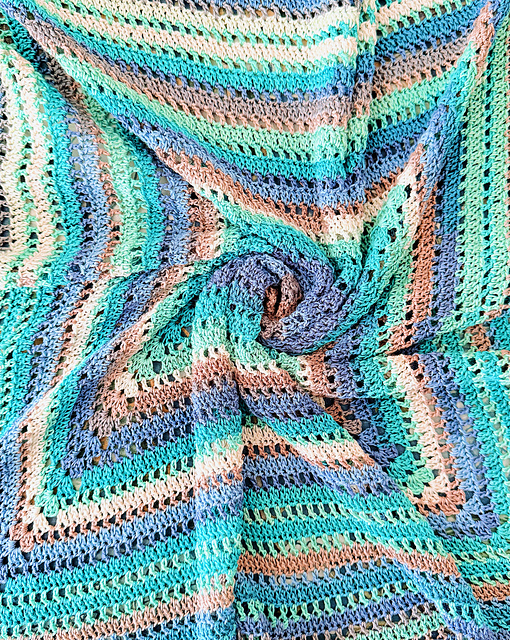
If you’ve been looking for a meditative crochet blanket pattern, something you can pick up at the end of a long day without wrestling a chart, the Quietwork Tideline Blanket was made for exactly that. It’s a single 36-inch square worked from the center out, with solid rounds and open mesh rounds trading places all the way to the edge. Simple on purpose. Slow on purpose.

The idea behind the Quietwork Tideline Blanket
Tideline is the first pattern in my Quietwork series, and it sets the tone for everything that comes after it. Quietwork patterns are designed somatic-first. I start with how the making feels in your hands and your body, and let the stitches follow from there.
So the structure stays deliberately plain. The first few rounds build the square. After that, you’re only ever working one of two kinds of rounds: a solid round of double crochet, or an airy mesh round. If the round you just finished was open, the next one is closed. You won’t need to keep track of it in your head for long. Your hands figure it out before you do.
The detail I most want you to know about is the fastening off. Every round is finished, fastened off, and then rejoined fresh at a corner. I know that sounds like extra work. Honestly, it’s the whole point. That small gap between rounds is where the practice lives: a few breaths, a stretch, and a quiet choice to keep going or to set it down for today.
This blanket takes as long as it takes.
The yarn does the rest. Mandala String moves gradually through its colors, so a solid round shows each shade deeply while a mesh round lets the same color open up and lighten. Over 42 rounds, that back-and-forth gives the finished square its rolling, tide-coming-in look.
Pattern details
- Craft: Crochet, written in US terms (English)
- Skill level: Easy / Advanced Beginner
- Finished size: About 36 in (91 cm) square after blocking
- Yarn: Lion Brand Mandala String in the colorway Tune, 100% acrylic, fingering weight (CYC #1), 350 yd / 320 m per 100 g ball
- Amount: 4 balls, approximately 1,400 yards
- Hook: 3.5 mm (US E/4), or the size you need to get gauge
- Gauge: 7 rounds = 3 in (7.5 cm), measured after Round 6 and blocked
- Notions: Tapestry needle, rustproof blocking pins, and a steam iron or spray bottle
- Techniques: Double crochet, chain spaces, slip stitch joins, and fastening off and rejoining each round. Worked in the round on the right side only, with no turning, no shaping and no seaming.
- Helpful extras: Stitch counts at the end of every round so you can check as you go
- Care: Machine wash cold on gentle; tumble dry low or lay flat, and keep it away from high heat
- Where to get it: $7 USD as an instant download from the Quietwork Tideline Blanket pattern page on Ravelry
Technique spotlight: fastening off and rejoining every round
If most of your blankets in the round have used a slip stitch join and a starting chain to roll straight into the next round, this method will feel different at first. Here’s how it works in general terms.
When you finish a round, you close it with a join, cut the yarn, and pull the tail through the last loop to lock it. For the next round, you attach the yarn again at a corner. Some crocheters do that with a slip stitch and a chain; others like a standing stitch, where you start with a loop already on the hook and work the first stitch right into the space. Whichever you use, follow the pattern so your corners and counts line up.
A few things make it easier:
Move your starting corner. Since you can rejoin at any corner, changing where you start each round keeps the joins from stacking into one visible seam line.
Handle tails as you go. Fingering-weight yarn is fine, so leave tails long enough to weave properly and run each one back through the stitches in more than one direction. On a solid round you can also work over the previous tail so it gets tucked inside the double crochets.
Count before you cut. The pattern gives a stitch count at the end of every round. Fastening off is the perfect natural checkpoint, so pause, count, and only then cut the yarn.
The mesh rounds rely on a classic open fabric: a double crochet, a chain, and a skipped stitch, repeated along each side. Those little windows are what let the color breathe, and they also make a fingering-weight blanket feel light rather than heavy.

Making it slowly: the blanket as a stitching ritual
This isn’t a project to race. It’s one to settle into.
Give it a small, steady setup. The same chair, decent light, your hook and the next ball of Mandala String within reach, and your phone somewhere you can’t see it. The point is that when you sit down, your body already knows what comes next.
Then let the two round types set your pace. Solid rounds are steady and even, stitch after stitch. Mesh rounds move a little lighter and quicker. You’ll start to feel that difference in your hands, like a slow inhale and a quicker exhale.
The pause between rounds is built into the pattern for you. When you fasten off, set the hook down. Take four slow breaths. Roll your shoulders, open your hands, unclench your jaw if it’s been working without your permission. Then decide. Another round, or tomorrow?
Both answers are right.
Because every round ends fastened off, the blanket is always in a tidy, finished place when you stop. You can leave it for an evening or a week and pick it right back up.
If you’ve enjoyed stitching at this pace before, my Forest Meditations Throw crochet-along comes from a similar place. And if you’d like to explore stitching this way with me one-on-one, that’s exactly what my private somatic crochet sessions are for.
Yarn, color and gifting tips
Sticking with the original yarn. I wrote Tideline for Mandala String in Tune, but the yarn comes in plenty of other self-striping colorways. Each one will give you its own version of that tide-like movement.
Substituting. Look for another fingering-weight yarn (CYC #1) and plan on roughly 1,400 yards. Then check gauge. The pattern measures gauge after Round 6, blocked, which works nicely here: crochet the center, block it, measure, and adjust your hook before you commit. A different fiber may drape differently, so treat that center as a test run.
Choosing color. A self-striping or gradient yarn plays up the tideline effect. A single solid color shifts the focus to texture, so the contrast between solid and mesh rounds becomes the star. If you’d like help thinking about color more intentionally, I shared some of my approach in my Holiday Ripple Throw and color guide.
Finishing. Blocking is what turns this blanket into a true square, so don’t skip it. For more on giving any crochet blanket a clean finish, my post on finishing touches for your crochet blanket walks through borders and final details.
Gifting and styling. A 36-inch square is a lovely in-between size. Fold it over the arm of a reading chair, lay it across your lap on the couch, or drape it at the foot of a bed. Since Mandala String is machine washable, it makes an easy-care gift too.
FAQ
Is the Quietwork Tideline Blanket beginner friendly?
It’s rated Easy / Advanced Beginner. If you can chain, double crochet and join with a slip stitch, you can make it. There’s no shaping and no seaming, and once the alternation begins, only two round types repeat to the end.
How much yarn do I need?
Four balls of Lion Brand Mandala String, about 1,400 yards of fingering-weight yarn in total, worked on a 3.5 mm (US E/4) hook.
Why fasten off after every single round?
It’s deliberate. The break between rounds is the built-in pause of the Quietwork practice, a moment to breathe and choose whether to continue. It also means you can rejoin at any corner and always stop at a tidy point.
Do I really need to block it?
Yes. Before blocking, the edges cup a little. A gentle steam or a spritz with water, plus some rustproof pins, lets it relax into a true 36-inch square.
You can get the Quietwork Tideline Blanket crochet pattern on Ravelry, and if you’re looking for something to start tonight, browse my free crochet and knitting patterns.
For new patterns and slow-craft notes in your inbox, come join me on Substack at The Maker’s Circle.
And when you make yours, share it on Instagram and tag @rohnstrong. I’d love to see your tideline.
I’m a contracted designer for Lion Brand Yarn.


Leave a Reply